August 2026 Meetup
Details
- Date: Tuesday, August 4, 2026
- Time: 1:30 – 2:30 PM
- Location: CS 3139, Computer Science Building, UW–Madison
What we’ll cover
At our soft opening, we spent most of our time getting to know each other and trading resources. This time, I want to turn our attention to a resource we’ve been quietly building in the background: The Burrows, BRUG’s website.
Recall that BRUG itself is the synchronous half of this community — the room we’re sitting in once a month. The Burrows is meant to be its asynchronous counterpart: a place where tools, strategies, questions, and general R know-how can live and grow between meetings, contributed by anyone who wants to add something. That only works, though, if the “anyone who wants to add something” part is actually easy to do. So the bulk of our time together will be a live walkthrough of two things:
- How to submit a pull request. I’ll show, step by step, how to propose a change to the site — a new resource, a fix, a blog post — so that contributing feels approachable even if you’ve never opened a pull request before.
- How commenting works. We recently wired up commenting across the site using giscus, which means you can leave feedback or ask a question directly on a page without needing your own hosting or account system. I’ll show you where that lives and how to use it.
We’ll close out the meeting with about ten minutes on a couple of ancillary topics, and — since we’re already talking about how the site and this group should evolve — we’ll use part of our time together to vote on how often we meet going forward and settle on future dates.
How to prepare
You don’t need to do anything before the meeting to participate, but if you’d like to get more out of the walkthrough, it may not be unreasonable to spend a few minutes beforehand with the following:
- Take a look around The Burrows itself, just to get a feel for what’s there.
- If pull requests are new to you, IBM has a short explainer on what a pull request is, and there’s also a walkthrough video that covers the same ground visually.
- For context on why we’re doing things this way, Write the Docs’ guide to docs-as-code explains the underlying philosophy — treating documentation with the same workflows we already use for code.
- And since most of what you’ll be writing on the site is Markdown, IBM also has a quick Markdown primer if that’s unfamiliar territory.
None of this is required reading — I’ll walk through the mechanics live — but having the vocabulary in hand ahead of time should make the demo land a little easier.
A note on cadence
We floated a monthly cadence at the soft opening, with the first Tuesday of the month as a proposed recurring slot. Nothing is locked in yet, though, and I’d rather we decide that together than have me declare it from the front of the room. Come with a sense of what frequency and timing would actually work for you — we’ll put it to a vote before we wrap up.
How to get to CS 3139
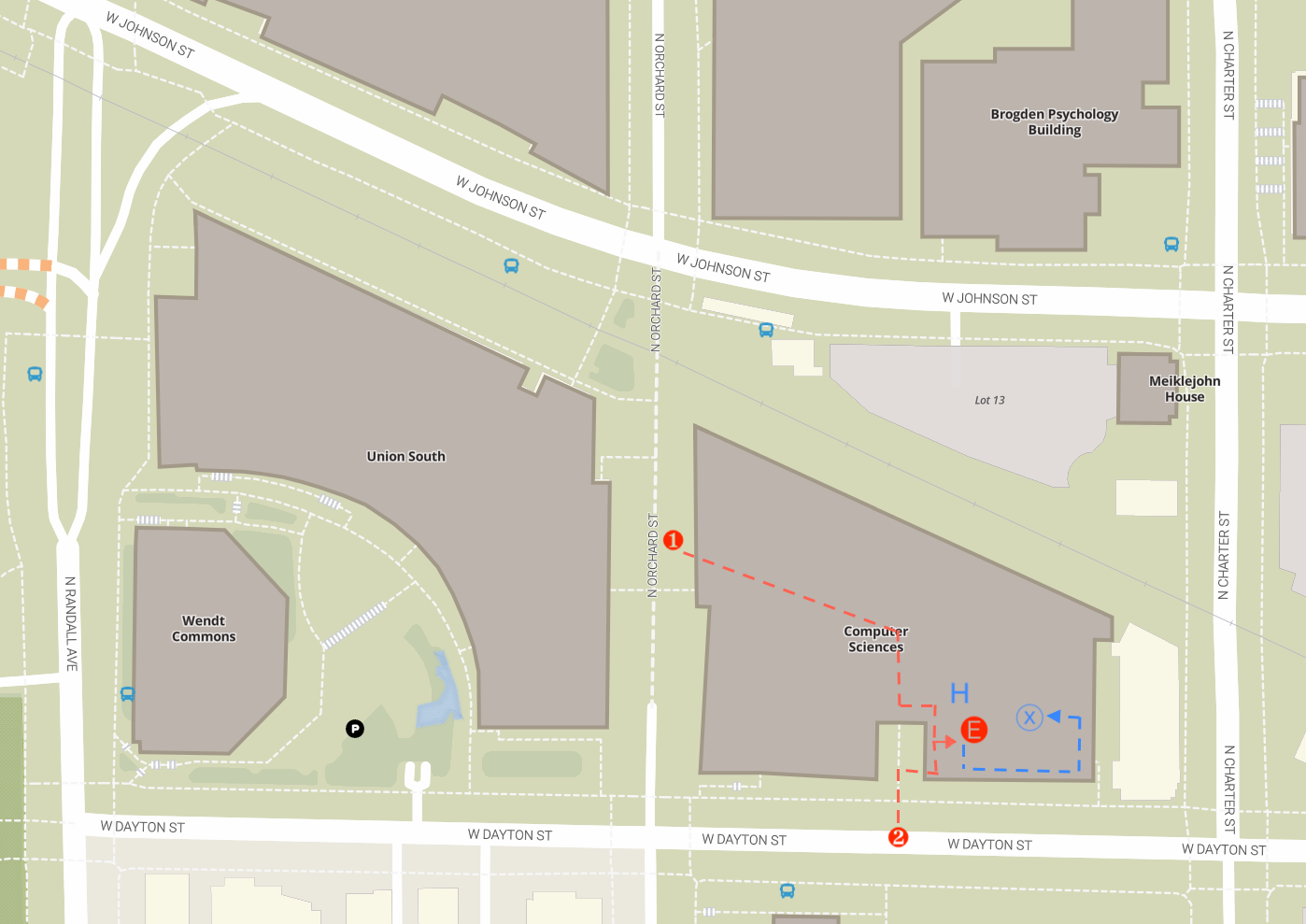
You can enter the Computer Science building via the door facing Union South (1) or (my favorite) via the entrance facing Dayton St (2). Make your way to the DoIT Help Desk (H) — you don’t have to talk to them, but do say hi; they crave human interaction. From there, find the elevator (E) and head to the third floor. Follow along the blue dotted line, and as always, (X) marks the spot